
Rhinoplasty in Korea 2026: Is It Safe for Foreign Patients?
If you've been researching rhinoplasty in Korea, you're far from alone. Across Reddit threads, Facebook groups, and TikTok comment sections, the question keeps surfacing: is it actually safe to get a nose job in Korea as a foreigner? Rhinoplasty in Korea has become one of the most searched medical tourism procedures globally in 2026, driven by the explosive rise of K-beauty, a post-COVID surge in international patient travel, and Korea's recent medical visa expansion that makes access easier than ever. And yet, legitimate safety concerns deserve honest, thorough answers. This article breaks down everything you need to know about rhinoplasty in Korea before you book your flight — from surgical standards and revision rates to recovery logistics and how to choose a certified agency that protects you every step of the way.
Understanding Rhinoplasty in Korea: Techniques, Standards, and Why It's Different
Rhinoplasty in Korea isn't the same procedure you'd find at a typical Western clinic. Over the past two decades, Korean plastic surgeons have developed a distinct surgical philosophy shaped by both aesthetic preference and technical innovation — and that expertise is increasingly being sought by patients from the US, Australia, Southeast Asia, and beyond.
Korean rhinoplasty broadly falls into two categories. Closed rhinoplasty involves all incisions made inside the nostrils, leaving no visible external scarring and offering a shorter recovery window. Open rhinoplasty** involves a small incision across the columella (the tissue between the nostrils), allowing the surgeon greater visibility and control — typically preferred for more complex structural work. Many Korean surgeons are particularly skilled at combining both approaches to suit the individual patient's anatomy and aesthetic goals.
One area where Korean surgeons have drawn global attention is their expertise in **Asian rhinoplasty** — specifically the nuanced techniques required to augment lower, flatter nasal bridges, refine bulbous tips, or create natural-looking height without the "overdone" appearance that can result from less experienced hands. These are procedures that many Western surgeons simply don't perform at the same volume.
Beyond technique, the infrastructure supporting rhinoplasty in Korea is world-class. Korea's medical system is regulated by the Ministry of Health and Welfare, and board-certified plastic surgeons must complete rigorous training and examination requirements. Many of Seoul's leading surgeons have published peer-reviewed research, trained internationally, and maintain membership in the Korean Society of Plastic and Reconstructive Surgeons (KSAPS) or the Korean Association of Plastic Surgeons (KAPS).
Perhaps most importantly, Korea's sheer volume of rhinoplasty procedures — performed far more frequently than in most Western countries — means that Korean surgeons build hands-on experience at a rate that is genuinely difficult to match elsewhere. In medicine, volume and specialisation matter enormously. When a surgeon performs a procedure hundreds of times per year, their skill level reflects that.
The latest techniques gaining traction in 2026 include ultrasonic (piezo) rhinoplasty for precise bone work, autologous cartilage grafting using the patient's own ear or rib cartilage for natural and lasting results, and computer-simulated 3D imaging during consultations so patients can visualise outcomes before committing to surgery.
Nose Job Korea Safety: Addressing the Real Concerns Foreign Patients Have
The most common question on platforms like Reddit — "Has anyone actually done their nose in Korea? How safe is it really for foreigners?" — is a completely reasonable one, and it deserves a direct answer rather than reassuring platitudes.
Nose job Korea safety starts with surgeon selection. The single biggest risk factor in any rhinoplasty, anywhere in the world, is an unqualified or under-experienced surgeon. In Korea, as in any major cosmetic surgery destination, there is a spectrum — from highly credentialed specialists with decades of rhinoplasty focus, to generalist clinics capitalising on medical tourism demand without the depth of expertise to back it up. This is precisely why working with a certified medical agency like K-MedLinker matters: vetting surgeons on your behalf so you're not navigating that spectrum alone.
South Korea's hospital accreditation system provides another layer of nose job Korea safety assurance. The Korea Institute for Healthcare Accreditation (KOIHA) evaluates facilities on patient safety protocols, infection control, equipment standards, and staff qualifications. Internationally, the Joint Commission International (JCI) accreditation — held by a number of Korean hospitals — is widely recognised as the gold standard in global healthcare quality.
Anaesthesia safety is another concern raised by foreign patients. Korean surgical facilities performing rhinoplasty under general anaesthesia are required to have board-certified anaesthesiologists present. Most reputable clinics also conduct thorough pre-operative health screenings — including blood work, imaging, and a review of medications — to identify any contraindications before proceeding.
Revision rates are a legitimate metric to consider. Studies published in Korean medical journals suggest that revision rhinoplasty rates among skilled specialists are consistent with, and in some cases lower than, comparable data from the US and Europe — though as with any surgery, outcomes vary and revision is always a possibility. Choosing a surgeon who specialises in rhinoplasty (rather than a generalist cosmetic surgeon) significantly reduces this risk.
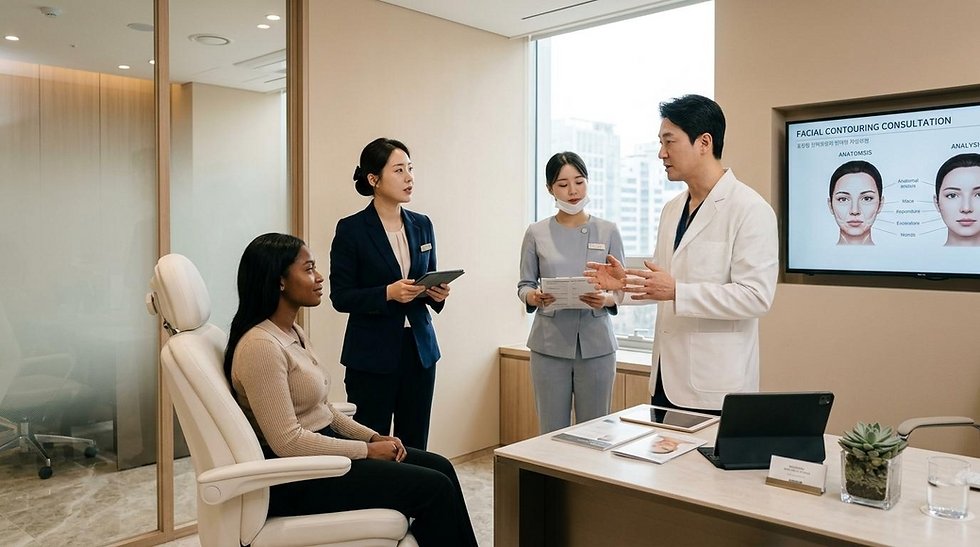
What about communication barriers? This is a real concern for English-speaking patients from the US and Australia, and a key reason to use a qualified intermediary. K-MedLinker provides full English-language support throughout consultations, pre-operative preparation, surgery day, and follow-up — ensuring nothing is lost in translation when it matters most.
Korean Rhinoplasty Cost and Logistics for Foreign Patients
One of the most compelling reasons patients from the US and Australia travel for rhinoplasty in Korea is cost. Korean rhinoplasty cost is significantly lower than in the US or Australia, even when you factor in flights and accommodation — and without any compromise in surgical quality when you choose the right provider. For a personalised cost estimate based on your specific procedure requirements, contact K-MedLinker for a personalised quote.
Here's what the logistical process typically looks like for an international patient:
Before you travel, K-MedLinker facilitates an online pre-consultation with your assigned surgeon. You'll share photos, discuss your goals, and receive a preliminary treatment plan. Korea's 2026 medical visa expansion has streamlined the entry process for patients travelling specifically for medical procedures, with dedicated medical tourism visa categories now available from the US, Australia, and several Southeast Asian countries including Indonesia, Vietnam, and Thailand.
Length of stay for a standard rhinoplasty is typically two to three weeks. The first week involves surgery and immediate post-operative monitoring. Weeks two and three allow for swelling reduction, suture removal (around day seven for open rhinoplasty), and a final check-up before departure. K-MedLinker coordinates all appointment scheduling to maximise efficiency without rushing your recovery.
Accommodation options range from budget-friendly guesthouses in the Sinchon or Hongdae areas to luxury serviced apartments in Gangnam — the district home to much of Seoul's medical cluster. K-MedLinker can advise on patient-friendly accommodation suited to post-surgical recovery needs, including proximity to your clinic.
Post-return follow-up is something many patients overlook until they're home. K-MedLinker maintains ongoing communication after your return, and your surgeon provides detailed aftercare documentation. Most of the visible swelling resolves within four to six weeks, though final rhinoplasty results can take up to twelve months to fully settle as residual internal swelling subsides.
Why Korea Leads the World in Rhinoplasty in 2026
The dominance of rhinoplasty in Korea on the global stage in 2026 isn't a marketing claim — it's backed by measurable indicators. Korea consistently ranks among the top nations globally for plastic surgery procedures per capita. The Gangnam district of Seoul has more plastic surgery clinics per square kilometre than virtually any other location on earth.
But numbers tell only part of the story. The cultural and professional ecosystem surrounding cosmetic surgery in Korea is unlike anywhere else. Surgeons who specialise in rhinoplasty often do so exclusively, building careers of extraordinary depth in a single procedure. Clinics invest heavily in the latest imaging technology, surgical equipment, and ongoing training. Patient care standards — including detailed pre- and post-operative support — are built into the standard model rather than treated as an add-on.
The global K-beauty wave has brought international scrutiny to Korean cosmetic outcomes, and Korean surgeons have responded by raising the bar further. In 2026, the growing demand from Southeast Asian patients — particularly from Indonesia, Malaysia, and the Philippines — alongside continued strong interest from the US and Australia, has further professionalised the international patient pipeline. Clinics are investing in multilingual teams, dedicated international patient coordinators, and partnership with certified agencies precisely because the global audience is now substantial and discerning.
For patients from the US and Australia specifically, Korea offers something rare: a destination where surgical excellence, affordability, and a genuinely world-class urban experience all converge. Seoul is a sophisticated, safe, and extraordinarily well-connected city — easy to navigate, rich in culture, and deeply accustomed to welcoming international visitors.
Frequently Asked Questions
Q. I'm from the US — how do I know the surgeons in Korea are actually qualified?
Korean plastic surgeons must complete a minimum of six years of post-medical-school training, including a specialised residency and board certification examinations administered by the Korean Society of Plastic and Reconstructive Surgeons. Many surgeons at top Seoul clinics have also completed fellowship training in the US, Europe, or Japan. When you book through K-MedLinker, every surgeon in their network is individually vetted for credentials, specialisation, and patient outcome records — so you're not conducting that due diligence alone from the other side of the world.
Q. I'm travelling from Indonesia — is the language barrier a serious problem?
It's a legitimate concern, and one that a good medical agency eliminates entirely. K-MedLinker offers consultations and full case management in English, and works with surgeons whose teams include multilingual coordinators. All consent documentation, post-operative instructions, and follow-up communications are provided in accessible English. Indonesia is also one of the fastest-growing source markets for medical tourism to Korea in 2026, which means Korean clinics are increasingly well-equipped to serve Southeast Asian patients specifically.
Q. How does the cost of rhinoplasty in Korea compare to the US or Australia?
Korean rhinoplasty cost is significantly lower than equivalent procedures in the US or Australia — even after accounting for international flights and two to three weeks of accommodation in Seoul. The exact figure varies depending on the complexity of your procedure, the techniques involved, and your individual anatomy. Rather than quoting a range that may not reflect your specific case, contact K-MedLinker for a personalised quote based on your consultation details. There are no hidden agency fees, and the initial consultation is completely free.
Q. What are the real risks, and what happens if something goes wrong after I return home?
As with any surgical procedure, rhinoplasty carries inherent risks including infection, adverse reaction to anaesthesia, asymmetry, and the possibility of revision. These risks exist regardless of where in the world surgery is performed. In Korea, reputable surgeons and accredited facilities mitigate these risks through thorough pre-operative screening, strict sterilisation protocols, and experienced surgical teams. If a concern arises after you return home, K-MedLinker remains your point of contact — coordinating with your surgeon for remote follow-up, providing documentation for your local GP, and facilitating any necessary in-person review if a return visit is warranted.
Ready to Take the Next Step?
If you've spent time researching rhinoplasty in Korea and still feel uncertain about where to start, that's exactly what K-MedLinker is here for. Navigating a surgical procedure in a foreign country is a significant decision, and you deserve personalised guidance from people who understand both the Korean medical landscape and the specific needs of patients travelling from the US and Australia. Rhinoplasty in Korea in 2026 represents a genuine opportunity to access world-class surgical expertise at a fraction of the cost you'd pay at home — but only when approached with the right support structure in place. K-MedLinker is a certified Korean medical agency connecting international patients with verified, specialist surgeons, handling every detail from your first consultation through to your safe return home.


Comments